

Key Takeaways
- KOC Represents Pure Authenticity as KOCs are real everyday users rather than celebrities. Their raw, unscripted reviews break through Ad Resistance and build far better Social Proof than traditional ads.
- Influencer Marketing is to Match Creators to the Marketing Funnel. Influencers build Reach (Top Funnel), KOLs build Credibility (Middle Funnel), and KOCs trigger purchase decisions to close the sale (Bottom Funnel).
- Allocating a budget to hire dozens of KOCs instead of a single Macro-Influencer spreads risk, lowers Cost Per Acquisition (CPA), and increases your odds of going viral.
Running paid ads, hiring A-list celebrities, yet sales still aren’t growing as expected? In an era where consumers easily spot traditional advertising, audience behavior in Influencer Marketing has shifted dramatically. People are skipping direct brand messages and putting their trust into recommendations from real everyday users instead.
That is exactly why Convert Cake frequently advises brands to understand What Is KOC, why it is essential for modern business, and how it transforms passive viewers into new paying customers. This article dives deep into every aspect of KOC, from its definition and core importance to strategic execution, turning your marketing investments into scalable sales growth.
Table of Contents
What Is KOC?
Consumers today know traditional ad playbooks inside out. When an ad feels overly scripted, people immediately scroll past. This shift has changed the competitive landscape of Influencer Marketing. Most brands now rely on the “voice of real users” for a more authentic, relatable tone. Let’s explore who these creators are and why they have become an indispensable factor for modern brands.
Definition and Meaning: What Is KOC?
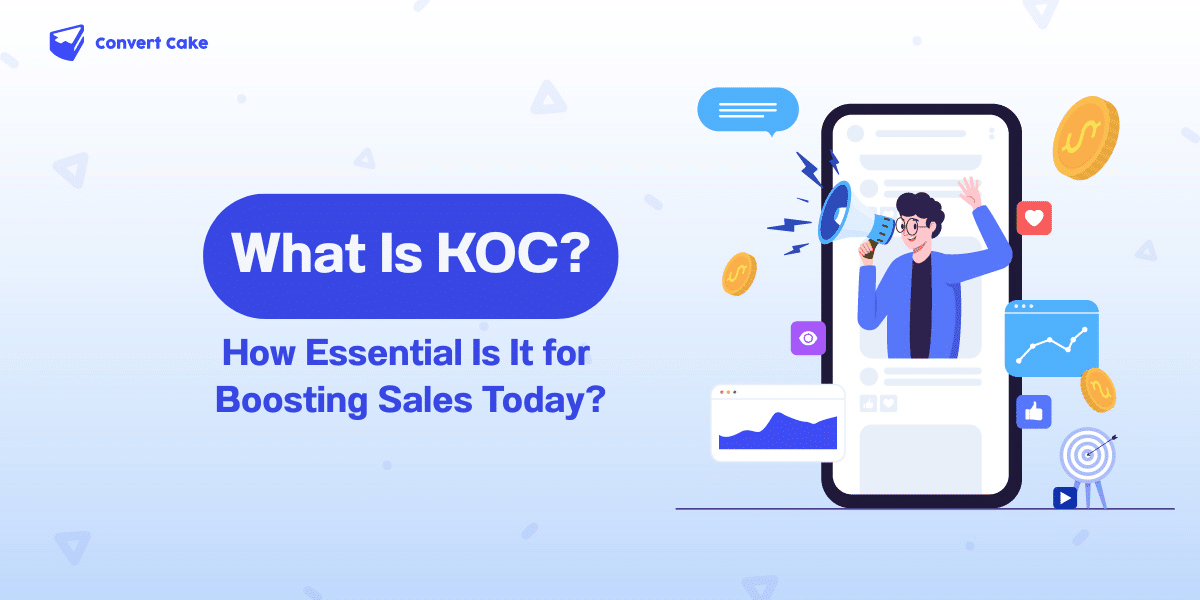
KOC stands for Key Opinion Consumer. Simply put, it refers to real everyday consumers who influence the buying opinions of others. This group isn’t made up of stars or celebrities with millions of followers, but ordinary people who purchase products with their own money, test them out, and share genuine experiences on social media platforms like TikTok, Instagram, Facebook, or X (Twitter).
The signature strength of a KOC lies in authenticity, sharing both pros and cons candidly. They typically have follower counts ranging from a few hundred to a few ten thousand (the Nano to Micro-Influencer range). Even without a massive follower base, they maintain close, peer-like interactions with their audience. This builds a far deeper level of trust than watching a celebrity endorsement.
However, scaling a campaign with dozens or hundreds of KOCs to drive actual purchases is no easy feat to manage in-house. Partnering with Convert Cake, one of the 10 Best Online Marketing Agencies in Thailand, is a key advantage. An expert agency helps craft your strategy, vet KOCs with real engagement, guide content direction without losing natural authenticity, and manage execution to turn views into measurable sales.
Why KOC Heavily Impacts Buying Decisions Today
In current online marketing, short-form video platforms like TikTok, IG Reels, and YouTube Shorts no longer prioritize follower count when pushing content. Instead, they focus on content engagement and relevance. Unfiltered, authentic reviews that highlight real pain points and demonstrate practical solutions consistently yield higher conversion rates than scripted celebrity clips. Viewers feel KOCs speak from genuine experience without ulterior motives or brand conflicts of interest.
Comparing KOC vs KOL vs Influencer: Choosing the Right Match for Your Funnel
To maximize marketing return on investment, brands must clearly distinguish between online figures. Before deciding How Many Types of Influencers Are There and which type fits each stage of the Customer Journey, it helps to see how they function together across the entire funnel:
Comparison Table: KOC vs KOL vs Influencer
Comparison Point | KOC (Key Opinion Consumer) | KOL (Key Opinion Leader) | Influencer |
Primary Role | Real end-user sharing hands-on experience | Industry expert providing deep insights | Public figure/Lifestyle icon attracting attention |
Content Style | Unscripted, authentic reviews focusing on function & practical use | Data-backed, authoritative, technically detailed | Visually polished, focused on image & lifestyle |
Reach Level | Niche / Micro Reach | Specific / Targeted Audience | Mass Reach |
Core Objective | Closing sales (Conversion) & building Social Proof | Building trust & credibility (Consideration) | Building brand awareness (Awareness) |
KOC vs Influencer: Functional Real Reviews vs Lifestyle Mass Reach
Influencers are typically celebrities, YouTubers, or well-known bloggers with large followings. The primary goal of hiring an Influencer is to capture widespread attention (Mass Reach) and build brand awareness. Followers often purchase products because they aspire to emulate the Influencer’s lifestyle.
In contrast, What Is KOC centers on real user representation, focusing on unembellished product functionality and problem-solving. People who buy through a KOC do so because the product solves an actual need, not out of idolization.
KOC vs KOL: Real Experience vs Specialized Expertise
KOLs (Key Opinion Leaders) are thought leaders with specialized authority, such as doctors, pharmacists, financial analysts, or tech reviewers. KOL content is packed with deep, accurate information to establish high credibility and authority.
Meanwhile, What Is KOC represents everyday consumers who don’t need expert-level credentials. They communicate from a peer-to-peer perspective, answering whether a product is easy to use, how it feels, and if it fits daily life, creating effective personal trust.
Summary: Matching Creators to Your Marketing Funnel
- Top of Funnel (Awareness): Use Influencers to broadcast ads to the widest possible audience and drive visibility.
- Middle of Funnel (Consideration): Use KOLs to offer deep insights, resolve doubts, and build strong product confidence.
- Bottom of Funnel (Conversion & Action): Use KOCs to flood the market with real user reviews (Social Proof), eliminating final buyer hesitation and driving immediate sales.
Benefits and Highlights of Using KOC to Drive Sales and Build Brand Trust
The surge in KOC popularity isn’t a temporary trend; it has become a cornerstone of Influencer Marketing for both legacy brands and emerging startups. The core strength of What Is KOC lies in delivering authentic trust that traditional ads cannot replicate. Here are the key advantages of using KOCs to scale sales and elevate brand credibility:
Creating Social Proof and Authenticity Traditional Ads Can't Buy
Before placing an order, modern consumers routinely search product names on TikTok or Google Reviews. Having KOC review content spread across platforms builds instant Social Proof. When buyers see dozens of everyday people giving consistent, positive feedback, they feel confident the product actually works, rather than viewing it as a single paid endorsement.
Low Cost Per Conversion, Ideal for Micro-Seeding at Scale
The budget required for a single Mega Influencer can easily be reallocated to hire 20 to 50 KOCs. Spreading budget via Micro-Seeding minimizes the risk of relying on a single piece of content, multiplies your chances of going viral, and delivers a noticeably lower Cost Per Acquisition (CPA).
Driving Impulse Buying Through Short-Form Video
KOCs typically film using mobile phones and natural light without expensive production setups. This allows their content to blend seamlessly into user feeds as native content. Viewers don’t feel like they are being aggressively sold to, which lowers ad resistance and triggers spontaneous impulse buying.
Ultimately, integrating KOCs into your strategy does more than just build a relatable brand image, it acts as the essential growth engine that converts passive impressions into tangible revenue.
Techniques for Managing and Hiring KOCs for Maximum ROI
Despite its numerous benefits, running a KOC campaign without structure or proper management can lead to off-brand content, missed deadlines, or low conversions.
To achieve sustainable success with KOCs, brands should apply a systematic management approach:
Selecting KOCs with Real Engagement and Target-Matched Style
Never look solely at follower count; analyze engagement quality and comment authenticity instead. Quality KOCs receive organic questions about product links, usage tips, and interactive conversations. Furthermore, their tone and delivery must align with your brand persona to keep content feeling completely natural.
Managing Budgets and Fair Pricing
Because KOC arrangements range from product gifting to paid video deliverables, benchmarking fair market rates is crucial. Marketers can consult an Influencer Rate Card 2026 to establish a realistic budget, avoid overpaying, and stretch seeding funds across the target number of creators.
Systematic Workflow Management and Deep Analytics
To maximize KOC campaign efficiency, minimize operational errors, and get the highest return on investment, brands should study Influencer Management 2026. Establishing clear workflows for selection, briefing, and quality control, alongside concrete KPIs like CTR, affiliate link sales, and UGC volume, allows you to measure campaign ROI with precision.
Digital marketing offers no one-size-fits-all formula. Smart brands avoid relying on a single creator tier. Combining brand awareness via Influencers, authority via KOLs, and authentic sales closing via KOCs provides the ultimate, well-balanced marketing mix for today’s market.
Conclusion
In an era of Influencer Marketing where consumers easily spot ads, relying strictly on traditional promotions is no longer enough to yield solid sales growth. What Is KOC answers this challenge by providing raw, authentic, and relatable content that builds powerful Social Proof and overcomes buyer resistance.
However, successful marketing isn’t about choosing KOCs in isolation, it’s about assembling a balanced marketing mix. Utilizing Influencers for reach, KOLs for credibility, and KOCs for closing sales forms the most robust and cost-effective growth strategy today.
If you want to structure your Influencer Marketing systematically, recruit the right KOCs, and achieve measurable ROI, Convert Cake is ready to help you plan, manage, and transform every campaign into sustainable sales growth.
FAQ
How does a KOC differ from a Micro-Influencer?
Micro-Influencers are content creators with 10,000 to 50,000 followers who focus primarily on content production. A KOC (Key Opinion Consumer) is an everyday user with followers ranging from a few hundred to a few thousand. KOCs focus on sharing real user experiences without flashy production, making them appear more natural and approachable.
How should brands set a budget for hiring KOCs to maximize ROI?
Brands should adopt a Micro-Seeding strategy by spreading budget across dozens of KOCs using a hybrid model of product gifting and per-video fees. Success should then be evaluated using performance metrics such as Cost Per Acquisition (CPA), Click-Through Rate (CTR), and sales generated via affiliate links.
Why do KOC review videos drive higher sales conversions than celebrity endorsements?
Modern consumers suffer from Ad Fatigue and often view celebrity endorsements as scripted paid promos. In contrast, KOCs share unscripted experiences as everyday users, addressing real pain points and practical outcomes. This builds genuine trust and prompts viewers to make confident purchase decisions.

Related Blogs
How Many Types of Influencers? The Complete Guide for High-Performance KOL for Your Businesses
What is a Mega Influencer? 2026 Strategies for Using 1M+ Creators to Elevate Your Brand
